
Montgomery Scheduled and Actual Release
A projected or scheduled date is planning information based on the sentence and facts known at the time of calculation. The actual release date records the completed event after final authorization. Those dates can match, but they do not have to. Jail credit may be certified later. A court may amend an order. Credits can be earned, lost, or restored. Another sentence, warrant, detainer, or continued-custody order can also prevent release into the community.
Pretrial custody works differently. A person awaiting trial has no sentence end date to calculate. A bond order can authorize release, but posting, jail processing, and checks for other holds must occur first. Dismissal of one charge also may leave another case in place. For a pretrial Montgomery County detainee, ask the court about the legal order and the jail about the actual release or transfer. Do not turn a hearing date or bond amount into a promised door-out time.
Montgomery Release Date Lookup
First identify the custodian. Montgomery County Jail controls its local custody event. The Montgomery courts control their orders. VADOC calculates dates for state prisoners according to the sentence and applicable credit system. A federal sentence belongs in the BOP system. Using the wrong locator can create a false gap, especially after a county-to-state transfer.
- Determine whether the person is pretrial, serving a local sentence, under VADOC authority, or in federal custody.
- For county custody, call Montgomery County Jail and ask for current status, release versus transfer, and the recorded event date.
- Check the Montgomery General District or Circuit Court case for bond, sentence, suspended time, amended orders, and probation.
- For state custody, search the VADOC locator by name or seven-digit DOC ID and quote only the date label actually displayed.
- Ask the calculating agency for the time-computation or release record if the public result is absent or unclear.
- Confirm the final event through the signed release document, updated agency status, or official notification.
The Montgomery County released inmate search provides the full custody-to-record chain. For a historical county event, request the existing booking and release entry. Ask for the date and time, release type, legal authority, and receiving agency if the movement was a transfer.
Note: Record the source and date of every lookup, because a court entry, public locator, and release document can update on different schedules.
VADOC Montgomery Release Date Search
The VADOC Inmate and Supervisee Locator covers people in state institutions, probationers and parolees, certain people under VADOC authority in local or regional jails, hospital placements, and Community Corrections Alternative Program participants. It accepts at least the first three letters of a first name with the full last name, or a seven-digit DOC ID. Optional location, race, gender, and age filters can help separate matches. VADOC says the data updates daily and can still be inaccurate or outdated.
The locator landing page promises location and release-date information. Research did not verify the exact label shown on a lawful person-level result. It may vary by custody category. Accordingly, do not call the interface field “projected,” “tentative,” “expected,” or any other label unless the live record uses that word. Quote the displayed label exactly, note the check date, and preserve the distinction between a prospective date and a completed release.
If a fully discharged person no longer appears, use the VADOC records route. Ask for the notification-of-release letter, signed Order of Release, actual release date and type, and discharge status. Public absence is not proof of the date. VADOC may redact exempt corrections or supervision material, while court orders and other public records can still document parts of the chronology.
Virginia Time Computation Inputs
The official VADOC Time Computation guidance shows why a sentence is not simple calendar subtraction.
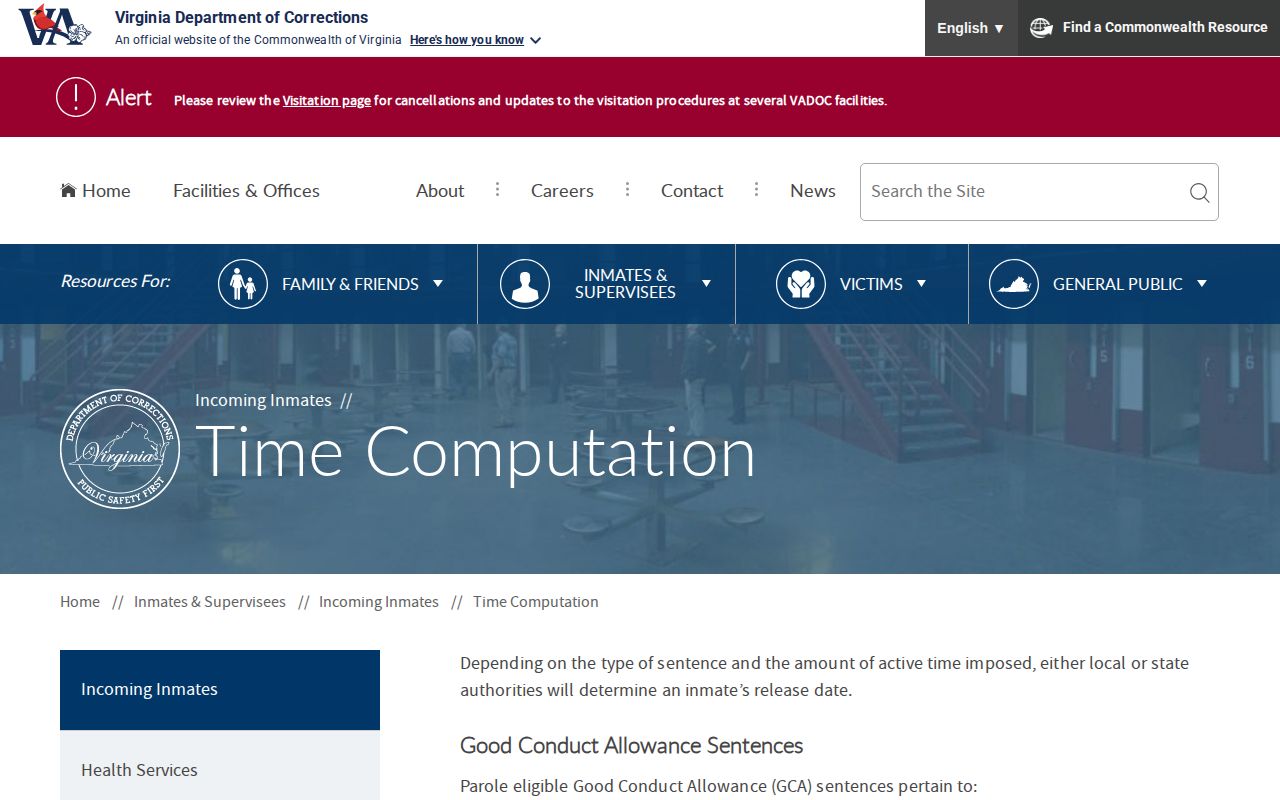
The guidance places the calculation with the proper authority and accounts for the law and record that apply to the person, rather than a generic percentage.
Core inputs include the sentence imposed, its effective date, certified jail credit, and whether multiple terms run at the same time or one after another. In legal terms, those structures are concurrent and consecutive sentences. The calculation also depends on the applicable credit regime, earning class, disciplinary changes, warrants, detainers, and later legal events. A detainer is a request or notice from another authority that may lead to continued custody or transfer.
| Input | Effect on the computation |
|---|---|
| Effective sentence date | Sets the legal starting point for the active term |
| Jail credit | Counts qualifying time already spent in custody |
| Concurrent or consecutive terms | Determines whether sentences overlap or run in sequence |
| Credit regime and class | Controls which earned-time rate can apply |
| Discipline and program status | Can change the credit class or credits available |
| Warrant, detainer, or new order | Can stop community release or require transfer |
Montgomery Earned Sentence Credits
For many felony offenses committed on or after January 1, 1995, Virginia Code section 53.1-202.3 supplies earned sentence credit rates and exclusions. Enumerated ESC-1 offenses can earn no more than 4.5 credits for each 30 days served. Other qualifying ESC-2 cases may fall at statutory earning levels of 15, 7.5, 3.5, or zero credits per 30 days, based on classification and eligibility. The offense and current law control the rate.
The phrase “serve 85 percent” is only rough shorthand for the restrictive 4.5-per-30 system. Thirty days served plus 4.5 days credited is about 86.96 percent of the adjusted 34.5-day cycle. It is not a universal Virginia rule and should not be used to predict an individual's date. Some offenses fall under different levels or exclusions, while old-law sentences use another framework.
Credits also depend on conduct and classification. A public estimate cannot account for an agency's later disciplinary action, class change, restored credits, or newly certified time. Ask VADOC for its own computation when accuracy matters. The statute explains the framework, but the person's official sentence file supplies the inputs.
Note: Earned credits affect sentence calculation, but an outside hold or continued-custody order can still prevent release into the community.
Old-Law Montgomery Release Dates
Felony offenses committed before January 1, 1995 may use the older good-conduct allowance system. Misdemeanor timing also has separate effective-date rules. VADOC calculates parole eligibility, mandatory parole, and good-time release for qualifying longer active sentences under that older system. Rates vary by classification and governing statute. Applying modern earned-credit math to an old-law sentence can produce the wrong result.
Parole adds another date. A Virginia Parole Board grant is a decision, not the physical release event. The person must agree to conditions, and VADOC still performs release checks. The Board's published grant date, an eligibility date, a computed good-time date, and the actual VADOC release date can all refer to different stages. Use the label from each record and do not merge them.
- Projected date
- A planning date calculated from the current sentence record and applicable credits.
- Parole eligibility
- The point when an eligible case may be considered, not a promised release.
- Parole grant
- A favorable Board decision that still requires VADOC release processing.
- Actual release
- The completed departure or transfer documented by the custodian.
Montgomery Jail Good-Time Policy
Local sentences use a county-jail framework. Virginia Code section 53.1-116 requires the jail to keep a written earned-credit policy. Unless a mandatory minimum applies, a person sentenced to no more than 12 months for one or more misdemeanors earns one good-conduct day for each day served when jail rules are obeyed. Qualifying presentence confinement can count. The statute also addresses work and program credit and limits certain post-1995 felony credits.
Request the Montgomery County Jail's current written policy rather than guessing how discretionary details work. The jail can also confirm the certified days credited to its own local commitment. A court's sentence remains the legal input, but the jail record shows how its policy and qualifying time were applied. Another charge or hold may still keep the person in custody after one local term reaches its computed end.
Home Electronic Monitoring is another local distinction. Montgomery County describes it for screened, sentenced, nonviolent offenders under section 53.1-131.2. Movement out of the jail building into electronic monitoring is continued sentence control in the community, not full discharge. A projected jail-release question should therefore ask whether the change is physical release, electronic monitoring placement, transfer, or completion of the entire sentence.
Why Montgomery Release Dates Change
VADOC performs a final review before release. Its procedure checks unsatisfied warrants, detainers, continued-custody orders, uncalculated sentences, and discipline or classification actions. A fresh court order or certified jail credit can alter the legal input. Loss or restoration of credits can change the time computation. The date visible today is therefore a snapshot, not a guarantee.
| Change | Possible result | Best source |
|---|---|---|
| Newly certified jail credit | Computed date may move earlier or later after correction | Jail credit record and VADOC calculation |
| Concurrent or consecutive correction | Total active time is recalculated | Sentencing order and time computation |
| Credit loss or restoration | Projected date changes with classification or discipline | VADOC sentence file |
| Appeal or amended order | Sentence terms or effective date change | Montgomery court order |
| Warrant or detainer | Community release can stop or become a transfer | Releasing and receiving agencies |
| Parole action | Eligibility or grant affects the release path, not instant departure | Parole Board and VADOC |
Confirm Montgomery Actual Release
For a VADOC sentence, the strongest completed-event records are the signed Order of Release or applicable conditions, the notification-of-release letter, and updated agency status. VADOC's facility-release material says final checks occur before departure. Release should occur by the deadline stated by the agency on the release date, weather permitting, but that statement is not a promise of a precise hour for a particular person.
For Montgomery County Jail, call 540-382-6904 and ask whether the person left for the community or transferred. A written request can seek the existing release entry and receiving agency. Court records can explain bond, dismissal, sentencing, or probation, but may not give the exact physical departure time. The Montgomery County VINE check can provide an alert or corroborating event, subject to lag and system handoffs.
Keep the date labels intact. A sentence date, eligibility date, planned release date, Board decision date, actual release date, and supervision discharge date answer different questions. When two sources differ, report both with their source and label, then ask the calculating or releasing agency to resolve the gap.