
Montgomery Parole and Probation
Parole and probation both place a person under rules in the community, but they begin in different ways. Parole is conditional release from an eligible prison sentence. The Virginia Parole Board makes the discretionary release decision, while the Virginia Department of Corrections, known as VADOC, manages field supervision. Probation comes from a court order. It often accompanies suspended jail or prison time, and it can begin after custody or without a state-prison stay. A Montgomery County court docket may therefore show probation even when no parole record exists.
Physical release and supervision discharge are also separate events. Physical release is the day a jail or prison lets the person leave its control or transfers that person elsewhere. Discharge means the agency's duty to supervise has ended. Someone can leave Montgomery County Jail on bond with no VADOC supervision, finish a jail term and start probation, or leave a VADOC facility on parole. The Montgomery County released inmate search helps establish the custody event. The supervision sources answer what came next.
| Point | Parole | Probation |
|---|---|---|
| Source | Conditional release from an eligible prison sentence | Court-ordered community supervision, often tied to suspended time |
| Decision record | Virginia Parole Board decision and VADOC release documents | Montgomery court sentencing or probation order |
| Current check | VADOC locator and supervising district | VADOC locator, court docket, and supervising district |
| End point | Parole discharge or other Board action | Completion, discharge, or later court action |
Note: A court sentence, Board decision, and supervision record describe different stages, so dates from those sources should not be treated as interchangeable.
Verify Montgomery County Supervision
The official starting point is the VADOC Inmate and Supervisee Locator. It covers people in VADOC institutions, parolees and probationers supervised by district offices, some people in local or regional jails under VADOC authority, institutional hospitals, and Community Corrections Alternative Program placements. It is updated daily, but VADOC warns that public information can be wrong or stale. The locator is not a full archive of every former Montgomery County detainee.
A careful check starts broad. The locator accepts the first three letters of a first name with the full last name, or a seven-digit DOC ID. Location, race, gender, and age range are optional filters. Match a result by DOC ID and custody history rather than name alone. If the record shows community supervision, compare it with the release document and Montgomery court order. If there is no result, do not infer discharge. The agency may hold an inactive record, the spelling may differ, or the person may never have entered VADOC authority.
- Confirm the person actually left the jail or prison, and ask whether that event was community release or transfer.
- Read the executed order for parole, probation, suspended time, or full discharge.
- Search the VADOC locator by name or DOC ID, using optional filters only to separate close matches.
- Compare the result with the Montgomery court docket or Virginia Parole Board decision that created the legal status.
- Contact District 28 with the full name, DOC ID, and specific public record that needs clarification.
Montgomery Supervision at District 28
VADOC Probation and Parole District 28 in Radford is the local routing office for Montgomery County. The official directory says the district also serves Radford, Floyd County, and Pulaski County. This matters because a statewide locator result may identify supervision without giving all case details. District staff can route a question or correction to the unit that maintains the record. Detailed conditions, reports, addresses, and investigative facts should not be expected as public data because Virginia law permits VADOC to withhold parts of a supervisee file.
VADOC District 28 - Radford
Service: Probation and parole routing for Montgomery County
Address: 2003 W. Main St.
Radford, VA 24141
Phone: 540-831-5850
VADOC facilities and offices
Bring a precise question. Ask whether the public record reflects active supervision, which district should receive a records request, or how to submit proof of an error. The office is not a substitute for the court clerk on the terms of a sentencing order. It also does not turn a projected release date into proof of actual departure. Each source controls its own part of the record.
Note: District 28 is a routing and supervision office, while the Montgomery courts remain the source for their own orders and docket entries.
Montgomery Parole Decision Records
The Virginia Parole Board public-meetings page is the calendar layer. It posts upcoming meeting information, agendas or live-hearing details, and past minutes. The observed schedule is irregular, so it should not be described as weekly or monthly. Since July 1, 2024, final deliberation and voting on a grant occur at a public meeting under the Board process. The calendar is not a person-by-person interview docket.
The Board's monthly decision reports are the results layer. Published fields can include DOC number, name, case type, decision and certification dates, outcome, reasons or conditions, jurisdiction, offenses, judgment date, and sentence information. Current official outcome terms include Grant, Not Grant, Continue on Parole, Revoke, and Discharge. A grant is not proof of same-day physical release. The person must accept conditions, and VADOC must finish sentence, warrant, detainer, and release checks.
The official Virginia Parole Board reports index shows the monthly decision-publication route used for Montgomery County parole records.
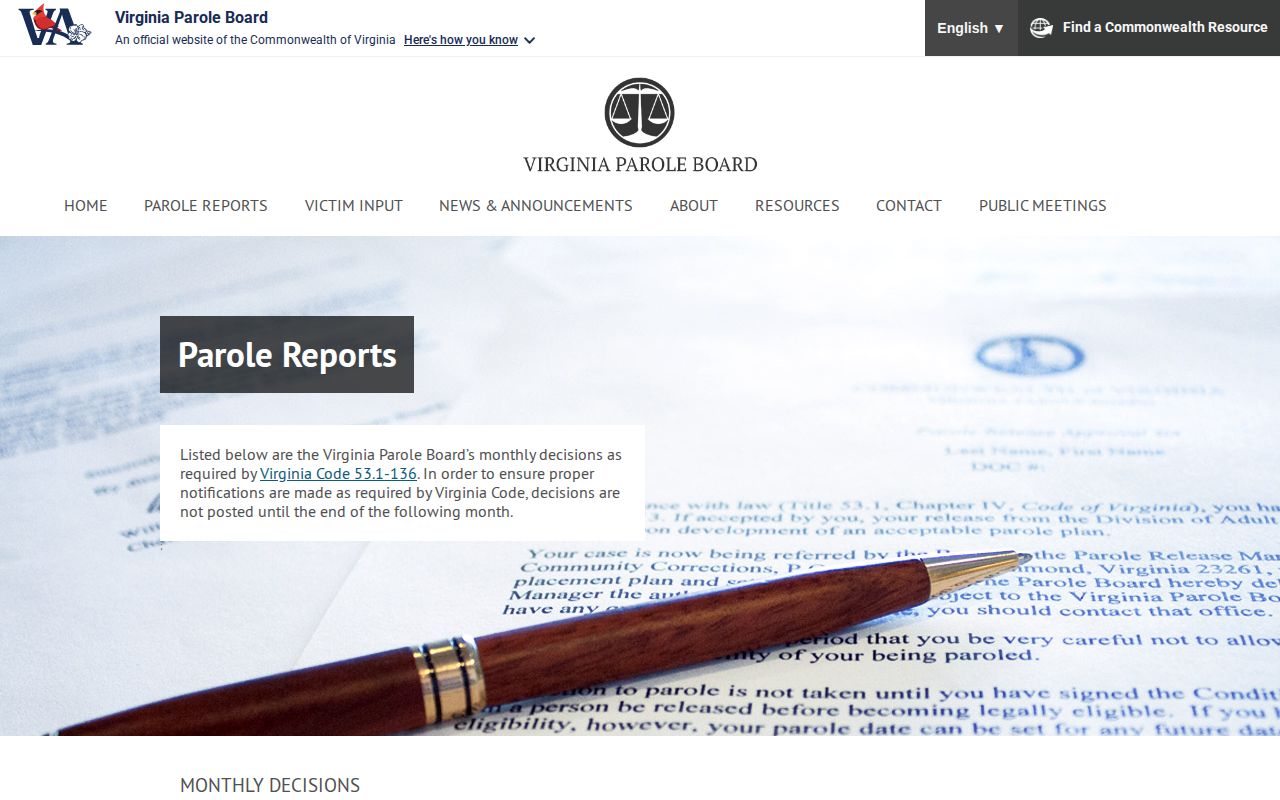
The index documents Board outcomes, while VADOC status and executed release records confirm whether physical release and supervision actually began.
Virginia ended ordinary discretionary parole for most felony offenses committed on or after January 1, 1995. Virginia Code section 53.1-151 still governs many older parole-eligible cases, while current exceptions depend on the offense date and record. Geriatric and terminal-illness conditional release use separate statutes. Eligibility never guarantees a grant or fixes a release day.
Montgomery Supervision Warrants
An absconder is a person alleged to have stopped reporting or otherwise left supervision without authorization. A violation does not erase the original community release. It can lead to an officer arrest warrant, court capias, or Parole Board warrant, followed by a hearing and possible return to custody. A capias is a court order directing law enforcement to take a person into custody. Exact consequences depend on the order, facts, and decision-maker.
VADOC's Most Wanted page is a selected wanted list, not a complete statewide absconder database. Absence from it proves nothing about warrant status. If a record indicates an active warrant, use the official reporting route or local law enforcement and do not approach the person. Court records can show a capias or violation hearing, while VADOC and the Board control their own warrant and revocation records.
Montgomery Supervision Terms and Discharge
Conditions are the rules attached to parole or probation. At a high level, they can require reporting, lawful conduct, approved travel, treatment, payments ordered by a court, or compliance with special terms in the signed order. The public locator does not promise to show every condition. A court order, Conditions of Probation, or Conditions of Parole is the stronger source. Do not assume that one person's terms apply to another.
Supervision can end by successful discharge, court action, Board discharge, expiration under the governing order, or a violation outcome. “Discharged” means the supervising duty ended. It does not change the earlier jail or prison release date, and it does not by itself describe the disposition of every charge. For an older inactive record, a focused VADOC request may seek the release letter, signed order, actual release type, and discharge status. VADOC can redact exempt parts of inmate and supervision records.
- Parole
- Conditional release from an eligible prison sentence with supervision in the community.
- Probation
- Court-ordered supervision, often linked to suspended time and not necessarily to a prison stay.
- Absconder
- A person alleged to have left supervision or stopped reporting without permission.
- Revocation
- A formal decision that can withdraw conditional release or suspended liberty after a violation process.
- Discharge
- The end of the agency's supervision duty, distinct from the earlier physical release.
Property After Montgomery Release
Release planning often turns on simple items such as property and identification. Montgomery County documents dual signatures when property is delivered and says an inmate may release excess mail or paperwork to family or friends. The Corrections Division does not publish a final discharge-property procedure, a release exit, or a pickup schedule. Those missing details should not be filled with rules from a nearby jail.
Call the Montgomery County Jail at 540-382-6904 before a pickup. Ask what property remains, who may receive it, what identification is required, and where the authorized exchange occurs. A signed property receipt can answer what the jail released, but it does not establish parole or probation status. For that question, return to the executed supervision order, VADOC locator, and District 28.
Note: Property release and legal discharge are separate records, even when both tasks occur near the same physical-release date.
Montgomery Supervision Evidence Chain
The strongest answer uses a short chronology. Start with the Montgomery jail or VADOC release record. Add the court's sentencing or probation order, or the Parole Board's decision. Then check the updated VADOC supervision status and District 28 routing. Finally, seek a discharge record when the question is whether supervision ended. VINE may corroborate a jail release or transfer, but it is not a source for the full terms of community supervision.
No single missing search result proves that control ended. Names change, public systems lag, records move between offices, and fully discharged records may require a request. Record the date and source of each check. That method keeps prison release, county-jail release, parole, probation, and final discharge in the right order.